Our Wonderful Followers who come back again and again to read about us...

Showing posts with label spinning wheel. Show all posts

Tuesday, October 18, 2022

Locally Created Red Oak Spinning Wheel

A couple of weeks ago we saw a very intriguing ad on Facebook Marketplace. Steve is always scanning the ads for anything of interest and he came across this handmade spinning wheel for sale.

An elderly gentleman who just lives 25 miles away in Menominee, Michigan was selling a spinning wheel that he made out of beautiful Red Oak hardwood. We decided to answer the ad and go check it out. I really didn't need another spinning wheel, but I thought this one might be nice to take along camping instead of my good one that I would prefer to keep at home. 

For a while now, I wanted a wheel with larger bobbins that I could do bulkier yarns with. Usually I only spin fine thin sock knitting yarns. But I have quite a large amount of wool roving in storage that I have wanted to spin up into thicker yarns. I would like to knit some thick hats, and having larger bobbins and a wider flyer to accommodate them would let me do it.

The wheel in the photos on the Marketplace ad appeared to be what I was looking for...


We made arrangements to meet at the woodworker's home in his little studio. It was a delightful afternoon meeting Bob, who was more than happy to demonstrate all of the creative parts of his handmade spinning wheel. He showed us all around his woodworking studio, demonstrating the other items he makes as well.


The wheel is rather primitive in nature and put together from all of the experience and talent that a wonderful old woodworker could come up with. He was rather inventive on some of the features and was so proud to show us how he put it all together.


He enjoys making the woodworking parts, and shows us how he also manufactured the metal parts. He made the orifice and the flyer to spin as evenly as he could, and added ball bearings on the main wheel. He made the pittman arm of metal instead of wood to make it last longer. 


He told us how the beautiful red oak lumber that he uses came from a tree that was cut down on his son's property. It turns out his son's property is in Peshtigo, which is a mere 10 miles from our own home!!  Can you imagine how thrilling it is to have a locally grown tree made into a wheel and about 10 miles away from where it grew????

What was extremely interesting is that this huge marvelous red oak tree that came down is that it tells a historic tale. It had telltale markings counting back at a certain number of rings where it had survived The Peshtigo Fire that happened 150 years ago. If you don't know about the horrific Peshtigo Fire, it was more dangerous and killed more people and was the same night as the ill-fated Great Chicago Fire in 1871.   

The Peshtigo fire was a large forest fire on October 8, 1871, in northeastern WisconsinUnited States, including much of the southern half of the Door Peninsula and adjacent parts of the Upper Peninsula of Michigan. The largest community in the affected area was Peshtigo, Wisconsin which had a population of approximately 1,700 residents. The fire burned about 1.2 million acres and is the deadliest wildfire in recorded history,[1] with the number of deaths estimated between 1,500[1] and 2,500.[2] Although the exact number of deaths is debated, mass graves, both those already exhumed and those still being discovered, in Peshtigo and the surrounding areas show that the death toll of the blaze was most likely greater than the 1889 Johnstown flood[3] death toll of 2,200 people or more.[4]

Occurring on the same day as the more famous Great Chicago Fire, the Peshtigo fire has been largely forgotten, even though it killed far more people. In total, the Great Chicago Fire took one-fifth as many lives as the Peshtigo Fire.[5][6] "Everybody's heard about the Chicago fire, and that got all the publicity at the time," said a volunteer at the Peshtigo Fire Museum, named Ruth Wiltzius, whose great-grandfather perished while trying to escape. "Peshtigo was a backwards lumber town then—who had ever heard of it? Chicago was the big city. Which one was going to get more attention?"[3]

Nonetheless, several cities in Michigan, including Holland and Manistee (across Lake Michigan from Peshtigo) and Port Huron (at the southern end of Lake Huron), also had major fires on the same day. These fires, along with many other fires of the nineteenth century had the same basic causes: small fires coupled with unusually dry weather. [7]

More info on link:

 
So this huge stately red oak tree that survived the Peshtigo Fire had now died and finally come down. It was split up by a portable sawmill and cut into planks. Bob has these beautiful planks and pieces of red oak wood that has been dried and cured. He is now using it to build various wooden spinning wheels, starting with one first for his wife and then one for his daughter. The third one he had made for his granddaughter, who apparently didn't want it, so he decided to sell it on marketplace. He also makes drop spindles, flyer spinners, kick wheel spinners, ball winders, and spindle type wheels.  He even makes these little primitive orifice hooks that can hang from an eyelet on the spinning wheel. 


Of course, I bought the wheel and took it home with me.  It's a much more rugged wheel in terms of spinning, and not as balanced and refined as my Wee Peggy from New Zealand.  But it does the job and spins the thicker bulkier yarns that I was wanting to create. 


He also makes lazy kates with a tensioning device to prevent the bobbins from over spinning as you ply off multiple strands to create finished yarns. I went back a week later and bought a lazy kate along with three more additional bobbins.  The thin tensioned string on a spring runs around the bottom grooves of the bobbins to prevent them from over-twirling when I pull off the yarns to ply them together.


When we went back to purchase the lazy kate, I asked Bob if he would please sign the bottom of my wheel for provenance, as well as the bottom of my Lazy Kate. I think I will print out a copy of this blog and keep it preserved with the wheel for anybody in the future when I am long gone.


He used to do craft shows, before Covid put a squash on that. He makes the most beautiful brooms! He makes full size brooms and also the smaller whisk brooms. He very generously gave me this one after I purchased the spinning wheel.


~~~~~~~~~~~


Now that the wheel is home, it sits in my She Shed when it's not in the motorhome on a camping weekend. I was going to leave it in the motorhome, but it's nice to grab and pull over to my chair on occasion when we are watching a movie or just looking out at the deer in the backyard. 


Here is the yarn that I first started spinning on the wheel. It was a beautiful rich brown but I didn't have enough of this particular brown wool to really create a complete hat.  It was kind of a "sample" to get used to the wheel.  Spinning thick is hard to do after spending so many years spinning thin! 


I pulled out some beautiful silvery gray wool and I then spun up enough to ply against the brown.  This is how the Lazy Kate works: I set the bobbins of single ply spun yarn onto each of the little metal spindles.  Then I gently pull the yarns off those bobbins and spin them in a reverse direction on the wheel to ply into the thick bulky yarn. 


With two full bobbins,
 I could now knit up a hat.


While we were traveling last week I brought the yarn along with me and started to knit up a thick hefty winter hat.  I usually never knit this thick, so I took a guess as to needle size, gauge and number of stitches around the head to start with. 


As the hat grew and grew, I realized it was going to be much heavier and larger than I originally intended.  OH MY! 


It actually turned out to be a very large man's hat. I guess I'm just not accustomed to knitting with such thick yarn. Next time I will have to do less stitches around to begin with and then the hat will be a little smaller size.  I didn't have the heart to tear it apart and start over. 


I enjoy knitting hats as we travel or if it's during a time when I need to wait, like doctor appointments. I enjoy knitting while we are traveling in the car because it's a small portable way to create something and keep my fingers busy.  Usually I just use scrap yarns and leftovers or combine thinner yarns to make thicker hats.   (the new extra large one is on the far left)


I should get a bunch of these listed in my Etsy store this week. It's gotten cold and windy and blustery and snow around areas of Wisconsin. Perfect time to get a winter hat! 

https://kareninthewoods.etsy.com/


Now I pulled out some rich caramel colored wool and llama blend for the next batch of yarn.  I think I will ply with a strand of creamy white wool for a hat.  This time I will start out a bit smaller? 


I spoke of watching deer up higher in this post.  Yesterday, as I was sitting in the She Shed, I saw two young deer wander into our yard in the middle of the day!   


They snuffled around underneath the bird feeders a bit, and then I went out and clapped at them and shouted to scare them off. They should not be so brave in the middle of the day, hunting season is coming! They need to learn to fear humans, not get so complacent around the houses here in town. 

The sun is shining today, but it's bitterly cold and windy. I am going to stay in and work some more on my quilting, and maybe do a little bit of spinning on the new Peshtigo Red Oak Spinning Wheel.


Monday, July 13, 2015

Working at the Calumet County Museum

(I really have two blogs to write today, one about the motorhome and one about the museum, so I thought I would split them up) 

Steve and I both have committed to helping at the local county museum.  We volunteer on Sunday afternoons to help out, talk to visitors, and do some repairs around the buildings.


The museum is run by the Calumet County Historical Society. This group relies solely on donations to keep running, and volunteers to keep it open.  They have done so much with so little.  We really enjoy being there, just to look, explore, read, learn and enjoy the wonderful information about the small farming community and tiny town of Chilton. 


There are two main buildings, a log cabin, and the only three legged windmill around, donated to the museum by my knitting friend, Kay. Steve has helped with some of the lighting repairs and I have offered to help whip the fiber display into shape and get things labelled correctly.


Although it was a hot, humid, miserable day, we went anyhow to help open up and man the museum for the afternoon.  Luckily there was a nice breeze coming across from the cornfields that helped.  After we got the museum ready and opened up, I took the best of the four spinning wheels and got to work. Sitting outside in the breeze helped.  Hmmmmm a little oil, a new drive band, some tweaking and twisting... and soon I got it spinning!!!  YAY!!!!!


Visitors came and went throughout the afternoon.  A couple brought in some delightful kids, by the names of Alex and Abby. They were so curious and intelligent.  Full of questions and asking "What did this cost back then?"  "How old is this?"  etc.  It was fun to listen and watch them explore each display area.  Then I wrangled them into helping me wind some handspun wool yarn onto some of the wooden display pieces.  Alex took the photo of Abby helping me.  They both were so curious and it was quite enjoyable to help them see things through the eyes of someone 100 years ago.

(printed with their parents permission)

Here are some of the fibers they helped me to process and display. 
Now things look a bit better with fibers around the tools.


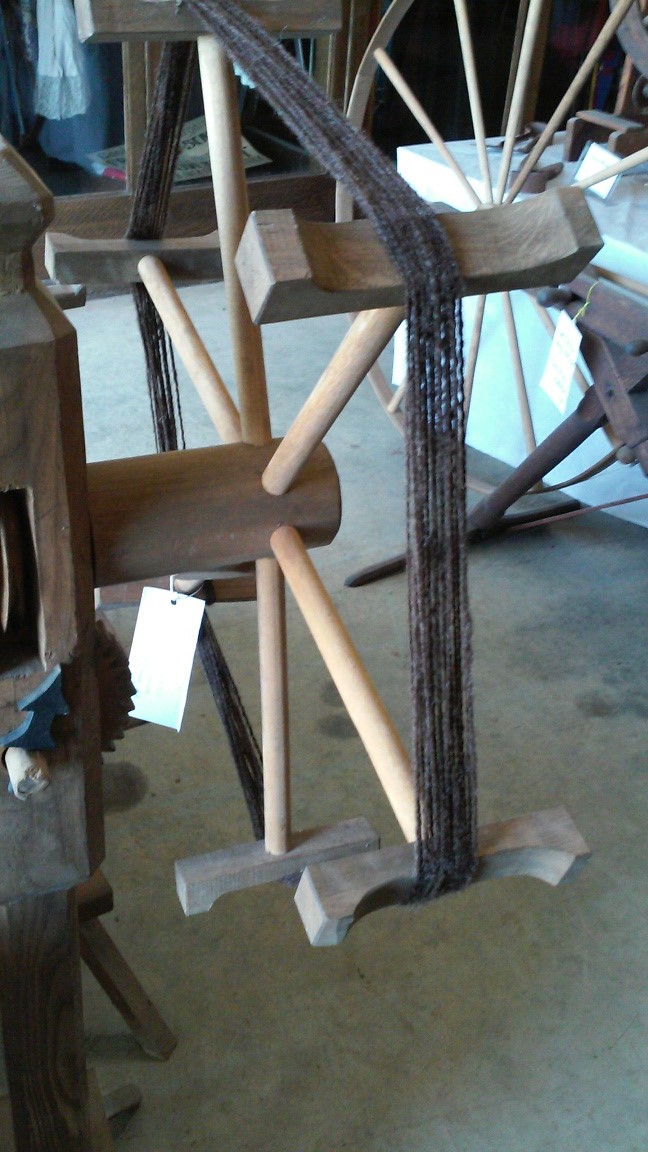
We seem to have a plethora of "yarn winders" which are used to wind on the newly spun and plied yarns, to be able to make them into the long loop type old fashioned skeins.  Now they can be dipped into sudsy water to wash the natural lanolin off the wool, or dipped into dye vats for color.


I still have more to do... clean up, oil the wood, string up the drive bands and arrange them in a nice order.  I get two great wheels to tackle (used for spinning cotton) and clean up more hand carders, hackles and shearing tools for the sheep.   Soon it will a display to be proud of.  For me, anyhow!  LOL 


Steve enjoys the other building to the east... donated by Mike Bolz.  It's full of the "Guy Stuff"  ... and there sure is plenty to look at!   When we help out at the museum, this is the building he mans, and loves to talk about machinery with the farmers and the other old guys who hang out here.


The main building to the west has more of the housewares, education, medical and historical archives.  A lot of books, photos, maps and display cases depict the history of this area.

Here are just a few Highlight Photos.....


 There are some lovely pieces from local buildings that have been torn down,
including these stained glass windows from a rural church.

The displays are arranged by small vignette rooms...
this one being store, grocery, and merchantile items


Here is a bit of household items, mainly showing a bedroom from the past

I am not going to bore you with a ton of photos of museum stuff, 
you just have to come and see for yourself! 

But THIS Is one of the most interesting items to kids.....

it's called a "transport basket"  
made by the Undertakers Supply Co. of Chicago.  


Soooo come on down to the museum next time you are in the area! 


We would love to have you visit, open on Sundays from 1-4 or by appointment.

Wednesday, February 4, 2015

Reinventing the Wheel.... Spinning Wheel that is!

I find myself sooo fortunate to have moved to an area so rich in fiber groups (or guilds as they are called) of people who share my same interests.

  • I have a monthly weaving guild in Menasha.
  • I have a weekly knitting group in Chilton.
  • I have a fun crafting group that meets occasionally at Terre Verde Coffee House in Chilton
plus----
  • I have a monthly spinning guild that meets at Hidden Valley Farm Woolen Mill near Valders. We are called the Black Sheep Spinners and folks from the various small towns around Chilton attend. It's so nice that Carol from Hidden Valley lets us meet in her place of business.


That is where I had to go last night.  The snow was blowing and swirling around by 6pm when I left for the meeting.  I drove our little Tracker and put it into four wheel drive as the roads were getting worse. As I traveled closer to the Lake Michigan location the "Lake Effect" snow was falling harder.  This phenomenon creates more snowfall closer to the water, and this area suffers from that condition. I followed a little old lady who was crawling along at 25 miles per hour, almost going in the ditch three times.  I wanted to go around her and get to my destination, but I felt I should follow her in case she DID need help.  Finally she turned into a driveway near St. Nazienz, so I was able to arrive at my meeting only 10 minutes late.  Seven of us fiber folks braved the weather to get to the meeting.

I arranged for the group to listen to a guest speaker named Chuck Spann, who is a talented woodworker.


He loves to create and make things of exotic woods. He has a workshop in his home to restore vintage spinning and weaving tools. I met him a while back, and he did some restoration work for me on a wheel.

Here is the blog post about that:

Here is where we meet, in the upper loft of the retail shop at


Chuck had brought a nice array of his prototypes of some new wheel designs. This one pictured below is an oak wheel with sturdy base and a nice large bobbin.  Large bobbins are great to spin a lot of yarn in one long continuous piece instead of using smaller separate bobbins. The wheel is small enough to store easily, and great for traveling.  It is only in prototype stage and he not yet making them for the masses.  He needs more time as he still works as a craftsman for a large yacht building company.  We said he needs to retire and make these fun tools full time!


Chuck makes these lovely drop spindles of a Turkish design.  What is great is that the two cross pieces of wood can be slid out once the spindle is fully loaded with handspun yarn.  Then you only have to slide out the pieces and the result is a finished ball of yarn.


Another spinner, Stephanie, is demonstrating to the group how well they work.  These Turkish spindles offer very easy portable spinning, which can be taken along in a car, using it while waiting for doc appts, long lines, visiting boring relatives, or just for having fun!


Chuck also brought along a weaving device known as an "inkle loom". These looms are used to make woven straps with intricate designs or patterns if wished. It's a small portable device, plus children can catch on to this process easily and learn to weave on it.


Guitar straps, belts, trims and decorative textiles can be made on these small inkle looms in long woven portions, or in shorter pieces they can be bookmarks, or as trims in cardmaking or scrapbooking.


Here is the Daneker spinning wheel that Chuck restored for me.  He also made three larger custom bobbins for it that are so much better than the original small bobbin.  It spins like a dream, and gobbles through my fiber at a hungry pace, and creates lovely soft skinny yarn for my sockknitting machine!


Last, here is shot of some of the spinning wheels in the loft at Hidden Valley Wool Farm and Fiber Mill. Carol grows the sheep with great fleeces to shear and process. We buy the fluffy clean fiber to spin up into yarn. Then we can knit, crochet or weave the yarns into textiles. It's so easy to be creative when surrounded by such wonderful inspirational tools!


While I was gone to my meeting, my darling Steveio was at home doing some preventative furnace work!   There is a little device on our furnace called an "Inducer Motor" that blows the exhaust air out of the energy efficiency plastic pipes out the side of the house.  If that little motor quits, the furnace will shut down before allowing noxious gasses to get into the house.  Our little motor has been making funny noises lately, like a loud whirring buzz of a bearing going to heck.

We decided to bite the bullet and replace that part now, before we leave for a 6 week vacation.  We do have a wi-fi controlled thermostat that shoots us a warning if the temperature in the house ever drops too low or if the furnace malfunctions.  But if this part goes to heck, we would have to get the house sitter to arrange repairmen access, pay a service call, and probably at emergency rates because things like that seem to go to heck during the nights or weekends!

Being handy, my dear Steveio decided to just order the part and change it himself.  Of course, the danged part was $550.  Ouch! The first part I picked up last week was missing the wire harness from the box.  I called back and they figured some technician robbed the box while on the shelf for the harness.  Oh vey!   So they ordered another one and it came in yesterday.

Now that Steve had all the correct parts....
 it was time....
 to....
 read....
 the .... 
DIRECTIONS!!!!

(note: this is a rare photo of a MAN reading DIRECTIONS!)

While I was gone to my meeting, he zoom zoom zoomed to get this project done.  He turned the furnace off, replaced the part, and got it up and running in no time flat.  He said it was an easy repair job, and he did the adaptation of some older part removal with a newer format, so more had to be removed than what was installed back in. Hey.. that means parts leftover???  But he did it all, with no service calls.  Saves us a lot of money that he is so handy. What a guy!   

Ahhhh so that is more thing that we should not have to worry about 
while we are gone on vacation.  

Stay tuned for launch sequence early next week.