Our Wonderful Followers who come back again and again to read about us...

Tuesday, July 6, 2021

Updating My Finlander Barn Loom

Although I would love to keep the Finlander Barn Loom as pristine and original as possible, I do need to do a couple adaptations to make it function better for my own use.

I looked back over my loom scrapbook and see that I now have owned 34 looms in my lifetime! That means somewhere along the way, I have gleaned bits and pieces of innovations from different loom configurations to know what I like best for weaving under certain circumstances. 

-There are adaptations you make to the big heavy rug looms. 

-There are adaptations you make to the small portable table looms. 

-There are adaptations you make for looms with fine thin fibers that maybe snarl or snag on each other, like mohair or silk yarns. 

I've added things like a bicycle rear view mirrors to be able to aim underneath and check the progress, making sure that I didn't skip any rows of intricate patterns of overshot or boundweave. I have added things like magnets to hold tips of scissors or large long weaving needles to darn in loose ends. I have added cup hooks to hang little printed cards of weaving patterns to follow. Over the years I've added and done things to looms to make them more "usable" to me.

Now it's time for a couple little upgrades and updates to this Finlander Barn Loom. 

~~~~~~

First, the old fraying sisal ropes needed to be removed. 

I replaced all of the ropes with good strong cotton sash cord, meant for hanging window weights on old windows. It does not stretch like clothesline or twisted ropes. Once it is tied at a certain height or length, it stays that way.

 
Once I am sure that my length is the correct distance for the largest optimal shed opening, I knot them off securely and tape up the ends to prevent fraying. I left some excess length on the two ropes down by the treadles because I may be adjusting those differently later on.

~~~~~~~~

Next, I added a good heavy handle that my friend Jim Burkett makes.  It is made from very heavy solid steel pipe. Not only does it make it easier to grab the beater, but adds packing weight to the beater as well.


I used to keep a couple of these handles on hand in my stash to add to looms that come into my studio. Then I remove them if the loom happens to be going on to a new owner. This is my very last handle! Jim is now retired and doesn't make these anymore. So I think this loom better stay here with the very last handle on, and never leave my studio, ever.

~~~~~~~~~

The next improvement I had Steve help me with. "Sectional Warping" means I can put a large amount of warp on the back beam using the easiest method, without having to wind long warp chains on that big warping reel. That is a tedious long process and subject to tangles and snarls and mistakes. By using the sectional warping method, I will be able to pack 40 or 50 yards of warp onto the back beam... when we are done with this improvement.

Steve carefully constructed four new sectional rakes, by drilling in holes every 2" on center. We added the oak pegs cut from 3/8" dowels. 


I glued them into place and stained them, and added a coat of polyurethane for protection. 


With careful measuring, we attached the rakes to the back beam. They need to be absolutely symmetrical so as the threads go around, the pegs are lined up with the previous row before it.


Now I can pack on a bunch of warp and get ready to weave a whole big batch of rugs. 

~~~~~~~~~

The turning motion of the back beam was kind of rumbling and rough where the ends slide down into cradles on the frame. We added some PVC vinyl slides to the cradle sections to make the back beam turn more smoothly.  


Now it rotates smoothly. Because I'm thinking that if I'm doing 80 turns per section to warp up this beam, x 15 sections, that makes 1,200 revolutions! It better turn easily....


~~~~~~~~~


Steve is still working out the details to attach a handle to the back beam to make it easier to crank. Previously, the warps had been put on slowly, by turning the other end of the beam a half revolution at a time, using a stick in the braking holes. I think we will find a way to wind on much faster. 


~~~~~~~~~
 
Somewhere along in this loom's lifetime, someone replaced this back support beam for the treadles. It's made with a newer piece of raw lumber that is actually stamped from a mill somewhere.  100 years ago they didn't do this.  I can't quite read the printing.


Since it was newer lumber, it didn't match the old aged patina of the rest of the loom. I laid down some cardboard, got out some rags, and rubbed in some dark walnut stain. I think it made a big improvement, don't you?


~~~~~~~~


Now here's one little nifty thing that I discovered, that I don't even need to improve! While I was weaving the last rug on the loom, I realized my little scissors needed a resting spot. Usually I just glue a magnet somewhere onto the loom to hold the scissors by the tip. But on this loom I discovered a nice little hole on the wedge used to hold the bench seat into place. Perfect for a scissors!


But I will have to remember to snatch it up quickly and put it in a safe place when the little grandkids come over. That is my routine, before they come in the door, I snatch up all scissors, pins, needles, rotary cutters etc from anywhere in my she shed. I call it "de-kidderizing". The youngest grandchild is only 4 and those could be dangerous items in curious little hands.

~~~~~~~

UPCOMING IDEAS FOR IMPROVEMENTS
 
An upcoming future improvement will happen, sometime, as I am keeping an eye out for exactly the right piece. As you can see, there is a piece of metal pipe used as the braking bar for the back beam.


There had been a wooden bar here, but it had been accidentally snapped off at the museum somewhere during it's display life. I have the partial piece, but it is going to need to be replaced with a wooden bar of the same diameter. I am looking for just the right sturdy strong broom handle or shovel/implement tool handle. Maybe a good one out of hickory? Or strong oak? I know the right one will come along, whether it's at a rummage sale, recycling center, or thrift shop.   It needs to be just a tad bit longer than the pipe so it can fit down into this cradle. 


For now the piece of pipe will work, but I really do want to get a wooden handle.

~~~~~~~~~

Speaking of pipes, someone had replaced the two bottom heddle bars of the harnesses with two pieces of conduit pipe. Although it is heavy, and works well, I would like to replace them with traditional wooden bars.


The top support piece for the pulleys is also a big heavy metal pipe. I am not sure if I could find a wooden bar that thickness. Steve suggested a piece of oak handrail or closet rod. In the meantime, this works just fine and I may just paint a dark brown. But if the right piece comes along, I may replace it.


~~~~~~~~

The little metal cradles for that top pipe, as well as the top of the beater swords, are kind of a mishmash of some homemade metal. Some of it is bent. Some of it has been resupported with nails, some of it has been boosted up from the back side with a block of wood. 


I think I will look for some heavy cast pieces of metal that will make a perfect cradle here for each of the components.

~~~~~~~~

I am also going to replace the string heddles sometime down the line. What is there now will work fine.  Either I will order up some really good strong seine twine from Sweden and tie my own, or I may just order the right sized texlov string headles and put those on. But for right now, like I said, what is there will work fine.

Now it's time for me to get off my blog, and go start the warping process. I already have the tubes of warp on the rack and the tension box clamped to a saw horse. I'm ready to start winding on.   ....as soon as we get that cranking handle thing figured out.


AS SHAMELESS SELF PROMOTION...  I sell a DVD on how to do the sectional warping process. It can be a daunting task to someone the first few times they attempt it. My DVD is a nice reference to look back to again and again if you are trying to sectionally warp a loom. 

I sell it on eBay:

HOW TO WARP A SECTIONAL LOOM DVD

And Etsy:

HOW TO WARP A SECTIONAL LOOM DVD


Just is case you wanted to learn more about sectionally warping a loom,  I think that my DVD is pretty helpful.


Monday, July 5, 2021

Provenance - Learning the History of My Finlander Barn Loom

Okay, now for Part 2 of the ongoing saga of my Finlander barn loom. 

If you read my blog post from yesterday, you will recall that a Menominee Range Historical Society member promised to get the director to dig through the museum donation records. They promised they would forward any provenance or information about the loom to me, if anything was written down when it was donated.

A few days later I had received a informative email with this intake form letter from when the loom was donated!


So let's see....

It was donated in 1992 by someone from the Lower Peninsula of Michigan, who lived near Detroit. How on Earth did it get up to the Menominee Range Historical Society at Iron Mountain, MI?  That area around Detroit really isn't really known for it's Finnish Population? 

Next, it says that the loom was owned by this person's grandmother? But no name of her? 

It says it was used in Ironwood, Michigan. Well that is about 130 miles away from Iron Mountain, Michigan, where the museum is located. So this really isn't a local resident's item put up for display?

It does say it's over a 100 years old. So that is very interesting. 

But I had a lot more questions!

Wellllll if you have questions, where do you go? I went to Google! And when I Google'd the name of this particular person who did the loom donation, I came up a good lead. I am hoping that he and his wife are both still alive, (I didn't see any listed obituaries) and it shows them still living at the same address. They are now both in their eighties!

I figured I had a pretty good chance of contacting these people to see what further information I could get.

I found some Facebook identities, and popped off a message to each of them.  It didn't look like they posted anything recently.  But I know on many formats for Facebook, you don't get the private messages from people who are not in your Friends List. They are sometimes hidden under a tab called "other".

So then I did the next best thing. I took out an old fashioned piece of paper, an envelope, and a stamp! I wrote a letter. I explained how I got the loom and how I was looking for any further information about his grandmother that he had listed on the intake paperwork.

A few days later the phone rang! Sure enough, here was this kind hearted gentleman calling me from Detroit. Oh my goodness! I grabbed a clipboard and a pen and started scribbling down everything that he was able to tell me. He was delighted that there was somebody that had gotten the loom rather than having it be discarded. But he was sad that the museum had decided to get rid of it. A few years ago, he had tried to go and see the loom on display, while visiting the Upper Peninsula.  Sadly, there weren't enough volunteers to open that particular building. He had visited the other two museum buildings at the two other different locations. But he was disappointed that there wasn't anyone to open the old library location.  He had really wanted to see his grandmother's loom.

Well now the questions from me started:

First of all, who was his grandmother?

Her name was Sanna Marie Salamaki Kangas.   Ahhhhh a Finlander!

And now the information started to flow. She was born in 1874 in Finland, was married there and had 2 children, then emigrated to the United States to Ironwood Michigan and had three more children.  She lived in Ironwood her entire life, in the same home. She passed away at the age of 78 years old in 1952.

She was married to a gentleman named Matt (Matti? Mathias?) Kangas, and he was a hard working miner in the iron ore mines of the Upper Peninsula of Michigan. He passed away in 1937, 15 years before she did. She always wore black clothing after that, for the rest of her life, a mourning widow.

Her grandson remembers her fondly, because he spent a lot of time with her,  and his family lived with her for a number of years during the Great Depression.

She always spoke Finnish, and never learned English. She would have the Finnish newspaper delivered each week to keep up on current events. Her social community was all of her Finlander friends and family.  Neighboring women would come and rent "loom time" from her. They would come to her home to pay to weave on the barn loom. Rather than moving the loom from place to place and renting it out that way, how enterprising it was that she would have them come to her home! Not only would she earn a little income from renting out the "loom time" and the loom was already threaded up with warp thread, she also got the pleasure of having people visit her. This kept her connected with the outside world. She never drove a car, so she depended on others to help her along, just as so many widows did in that day and age.

The home had no running hot water, only a cold water line into the house. There was no refrigerator. In the winter, they would keep things on the porch in pails and buckets of ice. In the summer, they had things kept cool downstairs in the cellar. 

She had a large garden, essential for providing for a family. She canned vegetables to sustain them through the long winter months. Her grandson especially remembers picking blueberries. They would journey into Wisconsin to pick blueberries together, and then go back home where she would can them into jars. He remembers wonderful bowls of blueberries, opened up from a jar in the middle of a cold snowy winter. They would eat them right out of the bowls. What a treat that she was proud to serve to her family.

Not only was she a rug weaver, she was also a prolific knitter. Her grandson remembers holding open long looped skeins of wool yarn between his hands while his grandmother rolled the yarn into perfectly round balls in preparation for knitting. He remembers her winding up the most perfect nice round balls of yarn. He said she was the best yarn ball winder that he ever knew. 

She was known to sit on her front porch and knit wonderful hats, sweaters, and the most warmest thick woolen hunting socks. Necessary of course for the winters in the Upper Peninsula of Michigan.

Her grandson recalls her sitting on the front porch in her rocking chair, happily knitting away, singing religious songs in Finnish.

She sounds like the most delightful person to have known. I wish I had known her. She sounds just like me. Besides my weaving, I also knit, can vegetables, and sing (somewhat badly). And I do love my rocking chair on the front porch!

Now... get this... the grandson promised to send me the family historical ancestry along with some photographs! Just wait until I get those! He said I will be really really pleased with what his wife is gathering together to send to me. Oh boy!!!!

~~~~~~~~

Now on to the loom:

The loom is over 100 years old. Sanna had it made for her by a local woodworker in Ironwood, Michigan. 

So that explains the obvious carpentry skills involved in making this loom.  I was correct in detecting that it wasn't just a rugged piece of equipment put together to help earn money on a farm.  It was a chosen piece of textile machinery that was created, planned, ordered and built by a skilled person.

She didn't live on a farm per se, but lived in a home with a big wood barn. Up North, everybody heated their homes with wood. And the loom was kept out in the woodshed or wood barn.

Her grandson remembers sitting with his little butt right next to her on that nice wide bench built into the loom. He would help her with the rag balls and he would wind the stick shuttles.

He was concerned if I had gotten the other equipment that came along with the loom, especially the stick shuttles. Ohhh yes, I did!

I got the big huge warping reel for winding warps that attaches to a beam in a barn. It is attached floor to ceiling, and rotates to wind up many yards of new warp to thread on the loom.  It's huge, so it's folded up in our garage for now. 


Also, I got the pile of various warping sticks, a warping raddle, some temples, (sometimes called stretchers), a jig for tying new string heddles, and of course plenty of the stick shuttles. 


A tin can full of bits and pieces,  hooks and tools...
 especially this little sley hook. 


 Many lovely stick shuttles and a jig for tying string heddles


 Temples, sometimes called stretchers,
to hold the rug at full width while weaving, 
so it doesn't draw in at the selvages


There were also a few little cute boat shaped shuttles
 that were used to weave the headers with warp thread.


Side note, I love weaving with stick shuttles instead of the thicker bulkier rag shuttles like many other rugweavers use. I have always liked stick shuttles and was very pleased to see a whole pile of them that came with this loom. Now I like Sanna even more! She weaves just the way I weave!

The grandson said that the rugs that were woven and sold to friends and neighbors, and people within the town.

Sadly, the grandson's family moved away from Sanna's home and went down to Detroit. Their father did not want them to grow up to become miners like his father before him. He wanted his sons to get an education and get out and see the world and have a occupation other than mining. So when the grandson moved away, he still fondly remembers visits back to see his grandmother. She only lived a few more years after they moved away to Detroit.

At that time upon Sanna's passing, the loom was disassembled and taken all of the way down to Detroit. 

It was set up at their home. I think at this point the sidebar was attached for multiple positions of braking on the back beam. I think also a different cross brace was put on for the treadles as well, because the wood is different, and newer than the rest of the loom. 

That answers the question of how the loom got down to Detroit. 

But now .... How did it get back up to the Upper Peninsula of Michigan?   And donated to a small historical museum in Iron Mountain, which is a 130 miles away from Ironwood???

The grandson said after his own parents passed away in the early nineties, he was left to clear out their home in Detroit. So he wrote letters to every museum in the Upper Peninsula, asking if they would like the loom as a donation?

Only one museum responded back! The Menominee Range Historical Society would love the loom. So he loaded it up and transported it up to the museum in 1992. The museum people gladly accepted it along with all of the pieces he supplied. Not only were there all of the tools and supplies and the big warping reel, but he even included a rug that had been woven on the loom. Everything was tagged and numbered and recorded in the files along with the paragraph of information shown on the 1st photo I put on this blog.

Now that I have come full circle with this part of the story, I anxiously await the rest of the family history as well as the photographs. That will make another blog post. 

~~~~~~~

If you recall on my last blog post I said there was a partially woven rug on the loom when I got it. We were able to preserve the threading throughout the moving process to my she shed. We put it all back together again with the partially woven rug on the beam. I was able to finish weaving that rug because there was a ball of matching rags that was supplied with the loom as well. 


I don't know who started weaving this rug. Was it the grandson's own mother, Felona, the daughter-in-law of Sanna? I don't know that yet.


But what did I do with that rug?


Well, on Saturday I boxed it up with a little note and I sent it to the grandson and his wife down to Detroit. I think they would be really pleased to have that rug from the loom. 

I know I am pleased to send it as an offering of thanks for all of the upcoming information that will be coming my way in the mail soon.

~~~~~~~

So I sit here now, at my loom, wondering about the woman who first owned it. 

I now know that Sanna really wanted this loom. She must have paid a considerable amount to have a carpenter create it for her. I know that she was somewhat isolated after her husband died and family moved away. By renting out "loom time" to other people,  it filled that need when she was not surrounded by her other family members. I know that she loved fibers and enjoyed her life by weaving and knitting and singing and rocking. I hope to learn a lot more about her, but for right now, I think she is probably one of the most delightful people that I would want to meet and go back in time to have a conversation with.

As my little grandkids sit by my side on the loom seat, with their little butts, I will think fondly of her grandson who took the time to fill me in on all the details of his beloved grandmother, Sanna Marie Salimaki Kangas.


Sunday, July 4, 2021

Finlander Barn Loom

This.

This is what happens when you have two well-intentioned friends, who are sure to enable your addictions!


They see something on Facebook Marketplace that they know you will want. Day after day, they send you little posts or reminders to go get it.

 Go get it now! 

Go and check this out! 

Don't let this one pass you by! 

It's only 80 miles away.

My best friends Rosie and Linda, who live in Missouri and Tennessee, respectively, didn't want me to miss out on the deal. It was too far for them to go themselves. But they knew that I SHOULD have this loom.

This beautiful antique barn loom was being offered by a small historical museum in the Upper Peninsula of Michigan.  As I understand it, they were condensing their historical society displays from 3 buildings down to 2 buildings. This barn loom was located in the lower level, actually the basement, of one of their buildings. They didn't have any room to display this large item in their other buildings. Their volunteer staff didn't have the ability or knowhow to tear it apart, transport it fully warped, and reassemble it in another location.  The decision was made to sell the loom, for a donation fee to the museum.

So, finally after weeks of watching it on Facebook Marketplace, Steve suggested that we should go up and get it. 

For a donation to the museum of $100, we agreed to fully take it apart and remove it, haul it up the stairs and out onto our trailer in front of the museum.

Steve and I both have experience in doing this. We have moved many looms in the past, including one other barn loom.

A long time ago, I had bought a barn loom from an old farm, also up in the Upper Peninsula of Michigan. I wove on it for a couple years in my studio, and I loved it. But it was BIG! Then I had a chance to buy 2 other looms that would take up the same footprint space as the one barn loom. So stupidly, I sold it! It went to a woman in Texas whose truck-driving nephew was going to transport it to her. I don't know if she ever got it set up. I've always regretted selling that barn loom.

Now I had a chance to get one again! Keep in mind, I already have 2 large rug looms and 2 smaller table looms for weaving. I really don't NEED another loom. But this one was calling out to me.  And my friends both made sure I heard it, loud and clear.

Here is the museum's website. You can go in here and walk around virtually. First click down on to level 1. By working your way through the rooms it's in the basement room, 2nd room on the right, and you can see the loom where it was on display.

Menominee Range historical museum virtual tour

Many items came with the loom, including the big warping reel, a pile of the shuttles, a jig for tying new heddles, and multiple warping and lease sticks. There was a tin can full of small assorted tools. Even this beautiful little sley hook. Everything was labeled with the museum's intake number.


The helpful gentleman assisting us promised to have the director of the museum look up the number.  He said she could try to locate any provenance for me on the loom as to who donated it and when. I looked forward to getting any information. Boy oh boy, I sure did! But I will save that for another blog post later. 

Now back to the loom disassembly:

We set to work taking the loom apart carefully, with plenty of photographs on each individual wedge and mortis and tennon joint. These barn looms were made to come apart fully warped and be moved from farm to farm. Multiple families would share a loom and each family would get it for a couple months at a time. They were made to be transported. But they were awfully large,  heavy and bulky;  usually hauled on big farm trucks or hay wagons, from place to place. 

Well, we didn't have a hay wagon but we had our cute little trailer behind our Saturn. Most of the delicate things were put inside for protection from the wind as we drove back the 80 miles down the highway to home. 


We made a small detour to Dobber's Pasty Shop for lunch, and a bag of a dozen frozen ones to take home.  


When we got home, I needed to figure out and re-arrange my she shed to see how I was going to get this to fit. I was working with graph paper and cut outs of various items in the she shed.  Arranging and re-arranging them on the paper grid.  


Steve said heck with that, let's just get it unloaded and hauled in and put it together, right in the middle of the she shed! So we did...

In no time at all we had it fully erected and put together. Each piece was perfectly back into place where it belonged. Each little wedge was the exact same one that had been in that joint for over a 100 years.  Right in the middle of the she shed.


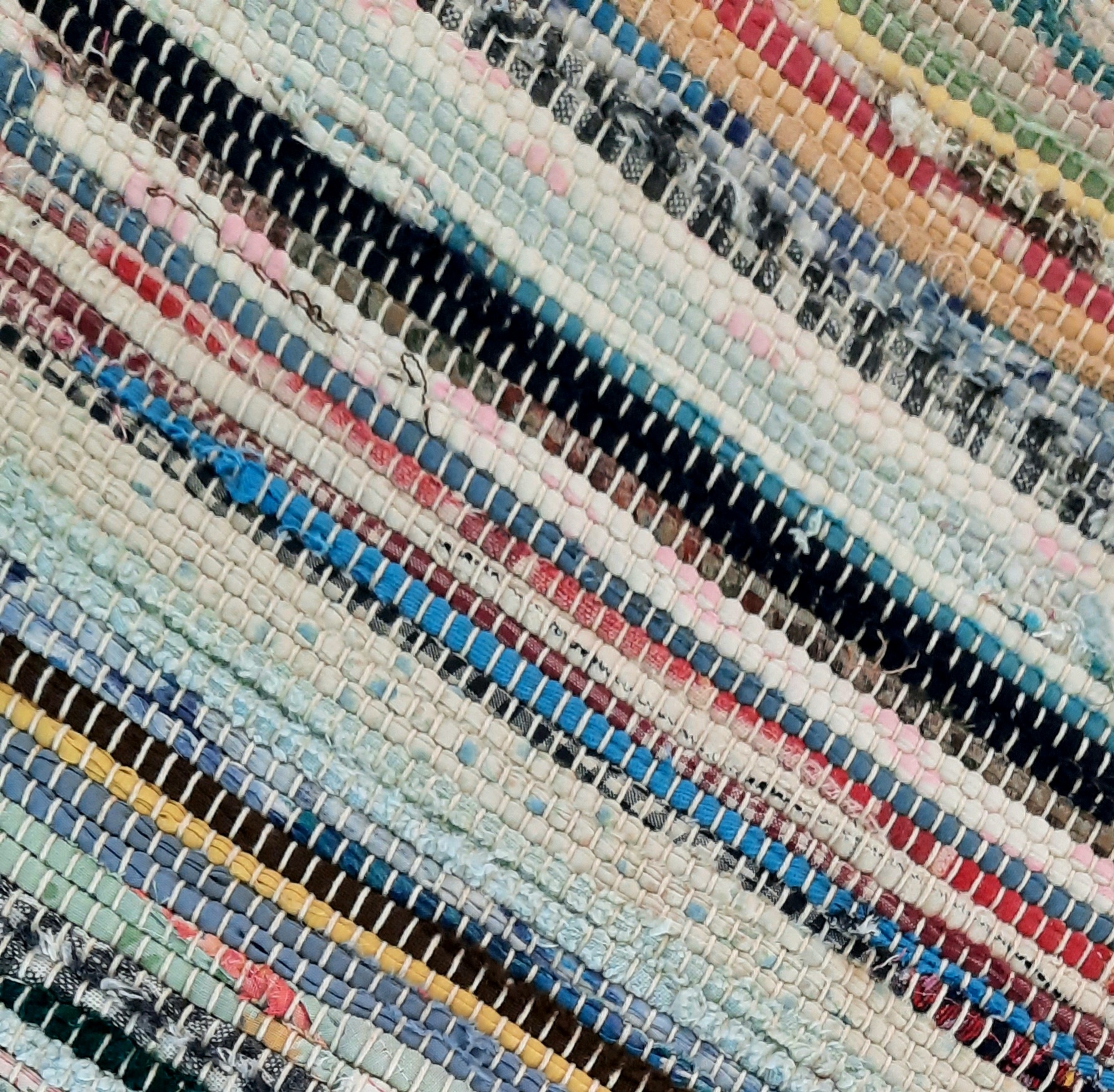
Along with the loom came an old rug that was tagged as having been woven on that particular loom. It had been donated with the loom. I set the rug on the bench seat. It made me smile.


There was also a partially woven rug on the loom itself, still threaded up through the heddles and reed, and wound onto the front beam.  It was started long ago, by whomever had the loom?  It was begging to be "finished up", I am sure.  

Wonderfully enough, a big ball of matching coordinated rags was also included with the loom. So of course, I wound up those rags onto a stick shuttle and went right to work. Weave weave weave and sure enough I finished up that beautiful rug!


 I tied the knots the old fashioned way


Tah Dah!  
A perfect Finlander Rug.


What I did with this rug will be in the next blog post... stay tuned! 

There was just something so wonderful about this loom.   Just being able to sit on the bench, grabbing that sturdy overslung beater, and packing those rags firmly into place.

An overslung beater works so much better than the under slung beaters of my other floor rug looms. This was extremely joyful and marvelous to weave at such a big monster.

I wondered about who owned it before?

I wondered how it came to be into the museum?

I wondered how many people grabbed that beater and slung it back-and-forth? 

I wondered how many rugs were woven on this big beautiful loom?


I could tell it been built with care and craftsmanship. The corner bracket braces, as well as the beautifully cut finial shapes on top of the pulleys, the decorative charming points on the top of the beater swords, and the side brackets to hold up the front beam. They all showed signs of woodworking craftsmanship. 


This was not some loom just tossed together by a farmer from long ago remembered instructions. Or images tucked away in their mind from a loom in the Old Country. No, this was a loom that was created with some craftsmanship and woodworking skills. Of course, it was homemade. But it was made with thought and a little bit of style.

The weavers on my barn loom restoration group confirmed that it was a Finlander Barn Loom. It was built in the "root" style of construction with the large arms overhanging the top of the loom. Many of these style looms were made out of a curved tree that was carefully cut in half to create the loom. This one was cut timbers in the same design. 


The Finlanders were a prominent nationality among the early settlers in the Upper Peninsula of Michigan. Many were iron ore miners, and some were lumbering men. They were hearty folk, used to the deep snowy winters, and determined to carve out a life in the new world of the rugged Upper Peninsula of Michigan.

There was just enough warp left on the loom to weave one more rug. I just happened to have an order from a customer that she wanted a rug of about that same length. She wanted it for her "camp" (also known as a cabin in the Upper Peninsula of Michigan). She was a co-worker of my daughter, and had heard about my rug weaving abilities through my daughter. 

She asked for a Finlander style rug with hit and miss design. She wanted me to work in some burnt orange and some reds, along with mostly blues and blacks. Dark colors that didn't show the dirt.

I set to weaving her rug right away and it was a joy. It seemed like the inches flew by. The rug was done and I was able to cut it free and still have enough dummy warp left to tie on a new warp. Then I can pull it through the existing string heddles and reed without having to rethread everything.


I hemmed up the ends of the rug for the customer and sent it off with my daughter to bring to work the next day. The customer was not in the office that week so the rug was left on her desk at work. 


The following Monday I got an appreciative email from the customer, expressing delight and extolling the beauty of the rug that she found on her desk. It was exactly what she wanted for her Up North Camp. Her family has Finlander heritage, her father is a 100% Finn. She was delighted with knowing that this rug was woven on a museum quality loom, right from the Finlander area of the U.P.

Next, I had to figure out how to rearrange the she shed. It was time to give this barn loom a permanent home. First we had to cut off an extra foot of desk space from my sewing desk configuration. Steve brought in the circular saw while I held the shop vac to suck up any of the flying sawdust.  


This would work. I still wanted to keep the higher bar portion for my ironing area, but the extra depth of the desk could be sacrificed to get everything to fit. 


We moved things around and shifted this and shifted that.  Soon we were able to give the barn loom a prime location right in front of the windows facing to the west.  This cleared up the main area of the floor and gave us space again. 


This works out really well in this location. I can pull it away from the windows to wind warp on the back beam, and slide it back into place during the weaving process. We put felt pads on the bottom of the loom feet so it does not scratch our floors.


I think this old loom is happy.... and from what I learned last night on the phone, I know the person who donated it is happy as well. Just wait till I tell you the provenance on this loom!!!!!   

Now you have to wait until the next blog post.