When reading some of these RV blogs, I really like to read the ones about folks’ RV units… be it campers, travel trailers, fivers, motor homes etc. I like to see inside and outside pics of folks’ rigs, and how they personalize them for travelling or living in.
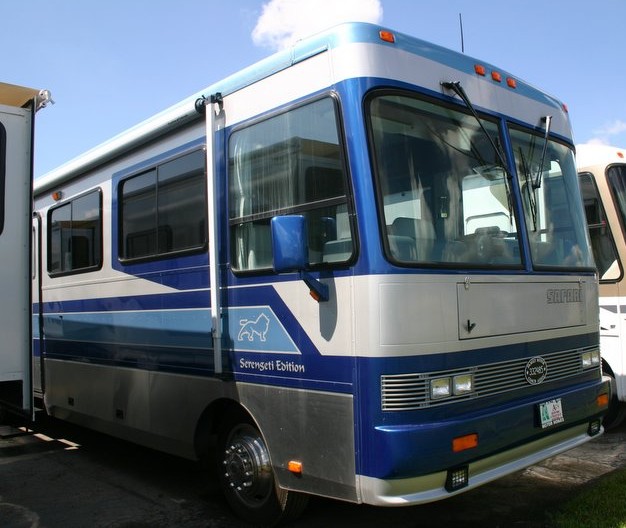
So, I thought I would work on a blog about our most recent motor home…. 1996 Safari Serengeti 38 ft Diesel with Cat 3126 and Allison tranny (there- got the technical stuff in for the guys!) This is what we saw on the lot:
We bought this rig in 2006… from Al’s Motor homes in Rockford, Ill. It only had 22,000 miles on it, and was in immaculate shape. With just one little glitch about 2 mechanics not understanding if each other changed a faulty turbo boost sensor, the rest of the purchase went very well. We negotiated into the deal:
- 6 new tires, mounted and balanced,
- all new belts and hoses,
- tranny, oil and radiator flush and all new fluids and filters,
- 4 new coach batteries, 2 new chassis batteries,
- a full propane 50 gal tank,
- and full diesel 105 gallon tank before we left.
Our UVH rating is 18,600 (Unloaded Vehicle Weight)
Our GVWR rating is 28,000 (Gross Vehicle Weight Rating)
GCWR-32,000 (Gross Combined Weight Rating)
And...
We weigh in with full water, fuel, and propane tanks and 2 people at 22,000 pounds without our gear when we first bought the rig.
We have about 8,500 pound capacity available from empty. Even with all our tanks full, (propane, fuel, fresh water and waste water) we still have around 6,000 pounds of CCC cargo carrying capacity above that.
Wheeeeeeeee what an adventure!
Most Safaris come from the factory each with a custom painted mural, by the Dame family. Here is a website of various ones collected:
other safari murals Most Safari’s have a hidden tiny animal somewhere in the mural. It makes a great conversation starter with folks, and little kids love to try to find ours. Here, I will help you find it on ours with a big red circle.
On the exterior, we have full body paint on aluminum exterior… (which means no delamination or fading decals or cracking fiberglass like our last rig) . We have one large silver fabric awning and smaller fabric awnings on all the windows around. On the roof are 2 AC’s, dual air horns, 500 watts of solar panels we added, two Maxi-vent covers and two venturi vent whirligigs. Sadly, people ask us if we are Detroit Lions fans because of this side logo. Nope, sorry, we bleed Green N Gold for the Packers!

Compartments:
(this is a long one, so I will only do one *C* today instead of 3)
Actually that is a mis-nomer because our rig doesn't really have compartments like most motorhomes or trailers, it's one huge storage basement wide open from axle to axle and side to side.
Some folks have asked me about how much storage we have or how we organize our basement compartment. It seems their rigs never having enough room, or they are worrying about cargo carrying capacity weight issues. When I tell them that is not an issue with us, they have a hard time believing it.
While newer rigs have multiple slides, which are very weighty by themselves, they also have storage issues with the slide mechanisms taking up valuable space. We don’t have the slides, so we have more than enough storage area in the basement of our rig, and weight is not a problem.
Even with all our tanks full, (propane, fuel, fresh water and waste water) we have almost 6,000 pounds of cargo carrying capacity. Being aluminum exterior construction instead of fiberglass makes a big difference, plus wall and roof supports are all aluminum too. We weigh in with full tanks at 22,000 pounds without our gear when we first bought the rig. Our rating is GVWR- 28,000 GCWR-32,000
I thought I would show you what we haul along in our rig. I had taken these pics for insurance purposes because most RV policies only carry $500 coverage on the personal contents, I kid you not! So please check your policy and ask your agent. We carry an additional rider for the rest of the possessions we carry above $500.
There is a huge basement storage area with stainless steel doors all around the rig, which look impressive. The basement is a wide open space, not separate little compartments. It is a huge pass through space with doors that open up high on each side. It is completely open side to side and front to rear between the front and rear axles. We can load in quite a bit because our GCWR is 32,000 and we are well below that.
Although we don’t have any slides, the floorplan we have allows for plenty of movement,
storage and our rig is a “wide body” model which adds extra width.
DRIVER SIDE: there are many compartment doors all along the entire length of the coach. It's open all of the way through to the other side!
Let’s start on the driver’s side. All of our stainless steel compartment doors rise upwards on struts and when shut, they lock securely on both ends instead of one latch in the middle.
I will go down the side from front to back, door by door.
Here is door number 1.
Whoda thunk of that space above the tank as a good spot to put a long tube for stowing the stinky slinky! For those of you who do not know what a "Stinky Slinky" is, it’s the flexible 3” hose used to dump the grey and black tanks…ewwwwwww We don’t want to keep THAT hose in our carpeted storage basement area.
On to the next door…..
We bought an assortment of these gray totes with heavy snap on lids. They are made by HOMZ
http://www.homzproducts.com and I see that Ace Hardware carries them.
The large totes measure 30 inches long by 18 inches wide.
The smaller totes measure 18 inches long by 14 inches wide.
We like them because they have a full handle on each side, not just a lip edge that you carry by the fingertips. Also, the lid fits firmly over the top and comes way down on the sides, which does not allow anything to get into the tote. We have more than enough totes, and keep swapping out sizes back and forth as we determine our needs in the future. The extra totes we keep in our garage or my fiber storage room for now.
In these matching big silver totes that fit perfectly, each one labeled for it’s contents: dog stuff, lanterns/propane stuff, picnic table and patio lights, diesel filters oil and supplies, raingear and boots, freshwater supplies, wastewater supplies, etc. and of course my fiber toys! At the far right is the plumbing compartment with all the manifold fittings for water areas in the rig and an outdoor shower.

In this next photo below, if you look close to the center of the rig, you will see a white poly 2x4 Cosco table and a larger 3x6 heavy black folding table. Both tables slide in nicely under the space under the suspended fresh water tank. We use them for eating and serving food when boondocking at places without picnic tables. Also good for extra table space when working on crafts or doing some crazy things like canning pickles (see Runkle Lake campground review or Paint River Forks in my archives) I can use these tables for an impromptu craft sale if we want while on the road at a campground too.
Here it is loaded up, each one labeled for it’s contents: dog stuff, lanterns/propane stuff, picnic table and patio lights, diesel filters oil and supplies, raingear and boots, freshwater supplies, wastewater supplies, etc. and of course all of my fiber supplies and toys! When we travel for a longer length of time, I have to have storage for my fiber supplies and inventory. This is "My Space" for storage.
At the far right is the plumbing compartment with all the manifold fittings for water areas in the rig and an outdoor shower.
This door is kinda a half access on the front, but behind the water manifold section is the water pump, expansion tank and some extra plumbing. It used to be walled off, but Steveio removed the wall piece for better access. Nice to have access to that mechanical stuff instead of it being buried behind a wall. You can see the daylight from right through to the open compartment on the other side of the rig. Steve usually lays his fishing rods in this area, plus the awning rod, which is reachable from the other side.
The next door behind the axle area is our power compartment... behind this stuff, we have a wired-in Progressive Industries electric management protection system to cover us for dangerous power surges or brown-outs.
We recently replaced the inverter from the old Freedom 2000W Heart (which burned out) over to this Tripplite 1500W. We also have a wired in Progressive Industries unit for surge and brownout protection.
In front of the things in the photo above, we store the power cords and adaptors for 50 amp to 30 or 20 amp if need be. Sometimes the cords get dirty from being on the ground, and it's nice to have this compartment separate from the clean carpeted center basement of the rig.
In the last compartment on the driver's side is our generator. We don't use it often enough because of now having 500 watts of solar panels on the roof. We have to remember to exercise it monthly with a load on it to keep it in tip top shape. We didn't always do that and had a very costly repair. Now it's a priority to take care of it.
It looks a little crooked in this photo because it was snapped when we were putting the generator back into place after having the rotor rebuilt. Rest assured, it is firmly bolted back into place now and works just fine. LOL
We don’t use the generator too often, but we have to run it from time to time under a full load to exercise it. Great to have in an emergency, or to run one of the roof AC units as we are driving down the road if need be during hot summer temps. But we really appreciate the peace and quiet when camping and don’t like to run it at all. So if you are a genny-fanatic, please park far far away from us?
PASSENGER SIDE:
Now on to the passenger side compartments:
These are the two most used doors near the passenger front between the side entry door and the front of the rig. We kinda packed them full, huh?
Someone asked on the blog about how does Steve fix stuff while we are on the road? Rest assured, he has ALL his tools along, even a vice that can clamp into the back hitch to work on items like an outdoor workshop.
This one is Steve’s favorite compartment:
Steveio filled one door space with his tool box area… where he carries all of his tools in a handy dandy toolbox he made from an old shop desk.

Stacked on top of the totes are our camping signs, picnic table cloth, kneeling foam pad and whatever else don’t get stowed away properly as we break camp the time before.
We carry along our two zero gravity recliners, and four folding chairs for company and our two macreme lawn chairs, a few little wooden tv trays for coffee clutching too. It all fits along with some room for the patio mat behind the chairs. And Steve's big air compressor alongside the chairs.
Yes, Steve puts the large air compressor right into this compartment too. It's used for his air tools, and also in case of a low tire, it's capable of going to the 110 pounds needed for our tires. It slides in and kind of curves back underneath the stairs in an open space usually not accessible. By just reaching in to flip the lever on, and grabbing the long air hose, he is in business! (of course when boondocking, we have to fire up the generator first to get the power to make this run)
Now we can move to the rear half of the passenger side.
The two interior entry steps into the rig to reach the main floor are the only things taking up any square footage in the basement storage area.
We also carry a folding table, extra leveling blocks, fishing gear and an air compressor. Our Safari does not have air bags, instead it has a special suspension on its Magnum chassis, made by BF Goodrich called Torsiliastic (sp?) which is comprised of rubber wedges and rubber fittings that give it a *Velvetride* …. yes, veryyyy smooth. So we need an on-board air compressor for Steve’s air tools and emergency tire filling.
This door number 3 is located at the left of the entry door. In here, we have the big solar controller for the solar panels on the roof. There is also a big pull out fuse to disconnect the whole system for repairs. I like that we have an outdoor tv antenna jack here. Sometimes we carry out the inside tv to watch packer games under the awning. There are both DC and AC electrical outlets and a little light to see what we are looking for in the dark too. We also stow the 6 large planks for under the tires for leveling the rig. (not in the pic)
In this next compartment, we stow the planks we use as pads under the hydraulic levelers, and also sometimes driving up the wheels on to get more level. Our solar controller unit and breaker box are also in this compartment, along with Steve's fishing poles, pudgy pie makers and the ever-coveted awning pull down rod!
Further down on the passenger side is the battery compartment. Since we installed the 500 watts of solar on the roof, these four 6v batteries store all the power created by the panels.
link to our Solar Installation blog post We can comfortably use lights, tv's, computers, coffee maker and other various electrical things and quietly solar recharge again the next day.
I talked about them more in depth a few blogs back. They are located behind the rear wheels. It is open around the sides and bottom for ventilation. There are 6 batteries in there now, but we can later move the 2 chassis (driving) batteries into a new rack in the engine compartment that Steveio made. Then we could increase the bank of coach (camping) batteries to a total of six 6volt golf cart batteries if we wish. Although with our five 100 watt solar panels that we installed, we may never need six batteries… four might be enough.
Now this last door is the cool stuff that you do not see on gas engine motorhomes. This is Steve's Control Central! He finds out all kinds of diagnostic stuff in this compartment. He can even start the engine from in here if the key is in the ignition. Pretty cool!
For those Techy Kinda Guys, here is the new head piece he re-vamped to fit the newer Fleetgard FS 1212 fuel filters that are available for our engine, now that the Racor Win 200/200 ones were discontinued.
Now let's move across the front of the rig.
Inside the front compartment are all the electronic fuse boxes and grounds etc.
I had to cut and paste a few pics of it, as it won’t all fit in one picture.
In here we also have a large fire extinguisher with access in emergency because this compartment does not lock. Hope we never have to use it, but it's a great location. If we are ever needing to help on an emergency on the road, it's easy to grab.
Yes we carry FIVE fire extinguishers in our motorhome:
Just stop and think for a minute. If you are asleep in your bedroom of your camper, and wake up to a fire in the middle of the rig, you probably have to bail out a window or emergency exit. The extinguisher is usually located up near the door which is locked from the inside. So even if you bailed out, you can’t even get back into your camper to get to it. Of course, they do burn up fast and sometimes there is nothing you can do to save it. But having a few around, plus an external one in an unlocked compartment is a real smart thing to do. Locating one at the far end of your rig, like your bedroom, where you might be trapped is a good idea too. Having one in an outside compartment means you can access it and quick blast at say a fire on the brakes or tire, or at a campfire that is spreading etc.
(keeping a hidden door key outside somewhere is a very smart idea, not just for a fire but for any time you might get locked out or lose your keys)

So.. that completes the tour of our storage compartments and how we organize them. In the future we see ourselves adding a few more totes of clothes (in vacuum sealed space bags) some supplies of my craft stuff, and perhaps my table loom when not in use. The loom folds up somewhat and fits in drivers side number 3 quite well.
Otherwise we are pretty well set for full timing, and more than adequate space inside the rig for the personal items we take along regularly and keep our kitchen fully stocked as well as the clothing and bathroom gear. So our weight load will not change much, right now fully loaded we are about 3,000 pounds under our CCC limit, so that is a good thing. We still have 4,000 towing capacity on top of that too. We currently tow a Geo Tracker that only weighs 2,200 pounds
OKAY... LET'S GO INSIDE!
Our rig has a side-entry door, which we LOVE! It is just about a deal-breaker item for us, after having been in both my parents and Steve’s parents motor homes with front entry doors. We realize the ease and sensibility of a side entry door that leads right into the kitchen. It’s a short turn to the left to the bathroom too.
We find a side-entry door is great for hauling food in and out to the kitchen, wet muddy dogs into the bathroom, or just the ease of running in and out to get things for cooking outdoors, which we do a lot of. We are not tracking food, dirty dishes, dogs and feet through the carpeted living room area and less wear and tear on the carpeting just by travelling back and forth. Plus, we ALWAYS take off our shoes, no matter what. Moccasins and clogs work great for slipping in and out of when camping.
Our other deal-breakers in looking at a rig are the need for BIG windows… all around. We hate the dark *tunnel* feeling of some rigs with dark woods and lots of walls. This rig has huge sliding windows and very few wall spaces. The last *deal breaker* was a king sized bed, for my tall man Steveio’s long legs to not hang over the end of a regular queen bed.
The large kitchen area, with plenty of drawers (NINE!) and plenty of cabinets, and lots of counter space were an added plus. There are more cabinets to the left over the kitchen table (the table pulls out with 2 more leaves to make it big enough for 4 of 5 people to sit around. Lots of storage and shelves inside the cabinets. The only downfall is the lack of an LP oven, it has just a micro/convention unit. UGH! We use an external LP oven from Coleman that I have talked about in previous posts. Or we fire up the generator to use the convection portion if we have to.

All of our cabinetry is solid Western Alder wood, native to the Oregon coast where our rig was made. There is no fiberboard, fake panels or papered layers to our cabinetry, which is something that wood-loving folks like us appreciate. Even our double door Dometic fridge has real wooden matching panels, custom fit from the Safari factory. Fountainhead countertops (like Corian) make the kitchen really durable and handy. I enjoy cooking in it.
All of the drawers are very wide and deep to the backs of the cabinets. Not much wasted space back there. They don’t make em like this anymore. Sigh. So we gotta keep this rig in tip-top shape to make it last.
There is a stand-alone icemaker over near the entry door under the wine-glass cabinet.
Now... forward to the livingroom area:
We went through some transitions in this room. At first there were two uncomfortable jack knife sofas. They were peach and frost blue tiger stripe upholstery, I kid you not! So right away I recovered them with this blue and gray textured corduroy fabric.
We later removed one couch and added a euro chair and ottoman.
That worked for a while.
Then we pulled out the other couch and tried two big recliners.
They took up a lot of room, but were more comfy than the couches.
Finally we settled on one wall-hugging reclining loveseat from LazyBoy which comes in three pieces and easy to assemble inside the rig. This is exactly what we wanted! Comfy, soft and takes up less room.
It really opened up the space. Now I can bring along a table loom and set it on the coffee table, or a spinning wheel or sockknitting machine. We can fit a queen size air mattress on the floor when the grandtots come. Lots of room now and when we rotate the captains chairs up front, we have additional seating for company.
Up in the cockpit, we have a neato pullout desk area, perfect for the laptop! We use Microsoft Streets and Trips with a dongle usb GPS, so it’s nice to have it handy and close to my co-pilot seat. It retracts and folds outta the way in flash for me to get up, or if we go inside somewhere for a bit, the laptop is stowed away and not visible to passersby's.
There is an AC outlet under the dash if we have the inverter on, and Steve wired in a DC outlet nearby so I can use that when we are driving down the road. I bought an AC/DC power source for my laptop and tablet, instead of using only 120VAC via the inverter. We did burn out one alternator in 2008, which might have been from driving all the time with the inverter on. Now we use the DC instead when driving on the roads, if at all possible.
Let’s walk back to the middle of the coach….
We have a large walk-through bath, with a full tub and shower. It works well for bathing dirty dogs, messy grandtots and yes, I can even lay down in it with a good book, a glass of wine, and a bath pillow. Yes, my knees are bent a bit, but it's still a bath tub!
We are pleased to have plenty of closets and drawers, with a Splendide washer/dryer combo installed. We added an Oxygenics shower head which is GREAT! It gives a frothy foamy full shower without wasting as much water that regular showerheads do.
Our last rig had a split bath, with a hallway through it, and small area for the toilet. We realize we like this roomy walk-thru full bath better. There is a wooden four-panel sliding pocket door that separates the bath from the kitchen and another sliding door leading to the bedroom. Good for closing the dogs off into the back.
Now for our Master Bedroom:
We didn't care for the huge mirror over the head of the bed,
so we covered it a well-loved Robert Duncan print called "April Storm"
suspended from the cabinets above on brackets.
The driver's side corner of the bedroom contains a little makeup area, lit mirrors, and overhead tv cabinet. We also have our controls for the inverter, and we installed a timer for the inverter to shut itself off at night when not in use. So I can have the tv on in bed to fall asleep, and not have to get back out to turn off the inverter. We most often camp without hookups, so using the inverter draws on our batteries all night long. That is why we turn it off via the timer.
The bedroom is a bit cramped due to the king sized bed, but it is a very workable situation for us, considering how much we need the king bed. There are cabinets all above around all three sides for added storage.
The whole bed lifts up for easy access to the complete diesel engine. You can step right inside on top of the engine to work on it, which makes for much easier repairs. Slides and sideway beds really complicate that access, and many diesel repair shops will shoot out an automatic “NO” reply when asking for engine repair work on a motor home, due to the difficulty of most rigs to access to the engine compartment. Once we explain the huge access area, they reconsider and take us in. Happened twice for us so far on the road.


After the first few years of using a scooter on a back rack, we installed a Blue Ox tow bar and haul around a Geo Tracker. Easier to tour the areas we visit and we can take the dogs along with us....
We hook up with a routine each time and double check each other's tasks.
It can shift easily into four wheel drive, which was fun out in the desert...
and I do appreciate the air conditioning as we ride along on hot days!
NEWEST MODIFICATION:
Because we now face a different direction when sitting on the loveseat, we decided to invest in another tv. The regular tv was installed up over the driver's seat and doubled as our backup camera screen. We looked at the power consumption of various TV's until we found a low-wattage LED tv from Vizio.
We decided to remove the overhead tv completely, and just have four panels of dark plexi cabinets... Steve took out the tv cabinet and made it shorter to avoid the "head banger" feature of hitting his head on it!
Here is how it looked before
with the big "head banger" cabinet hanging into the driver's area.
We removed the tv and Steve shortened up the cabinet from the top down
so it would sit level with the rest of the cabinets
Of course, he had to reroute a bunch of wires
and stereo stuff and back up camera stuff
The backup camera signal used to come in on that overhead tv...
now we put the cable to a small monitor between the dash consoles
A fellow Safari-ite Bill sent us an extra plexi glass door to cover the open space!
We had to move over one of the small tweeter speakers for the surround sound
There... done!
It looks SO much better.... and gives us more windshield view too
Now that the tv is gone over the drivers area, we only use the flat screen in the livingroom space. Now we mounted our flat screen onto a bracket located between the two windows. It works much better there!
(I love Andy Griffith and Mayberry!)
We also put a tv arm in the back bedroom spot,
with a smaller more energy efficient Vizio flat screen too!
Well, that is about it for our grand tour. This is what a 20 year old motorhome looks like if you keep it in good repair, check for roof leaks, do routine maintenance and drive it carefully. These diesel engines are made to last a long long time. So as long as we keep the chassis and exterior in good condition, we will enjoy it for many years to come. This year we qualify for "collector plates" when we go to license it... meaning no more yearly fees!







 Posts
Posts

